











By Leonard Kamugisha Akida,
KAMPALA
Universities have been urged to embrace artificial intelligence (AI), drone technology and space science to prepare graduates for a rapidly evolving global economy.
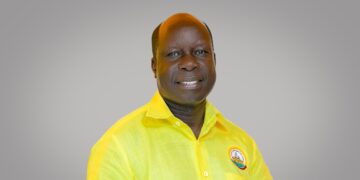
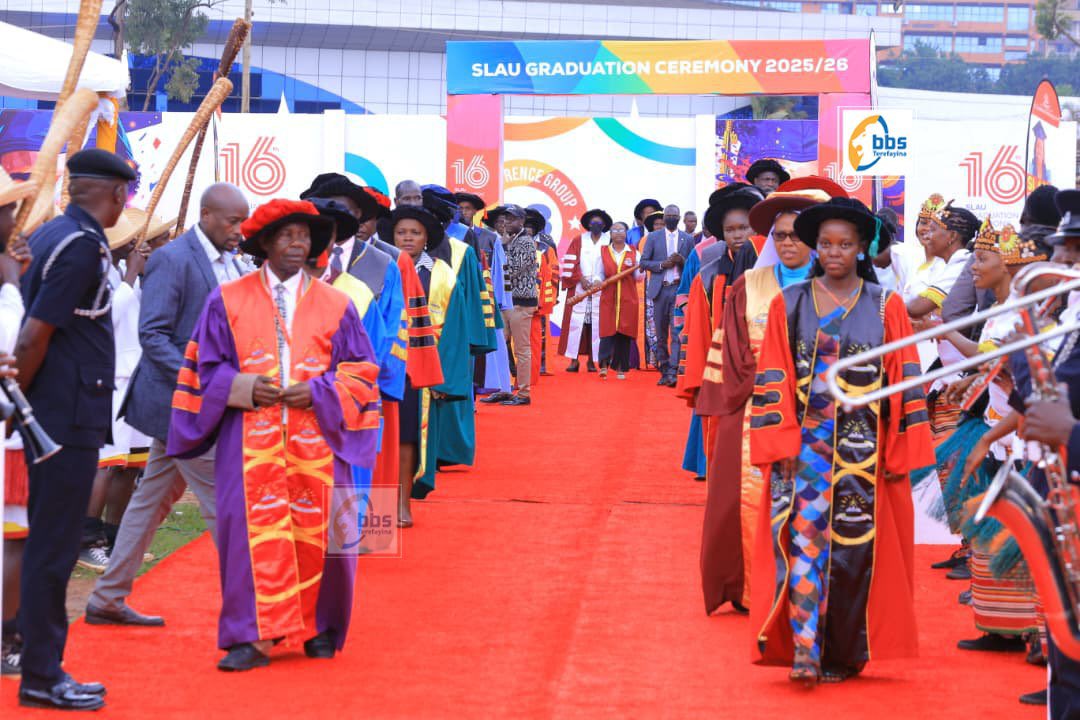
The call was made by geo-information and space scientist Dr Deo Apollo Musiisi during the 16th graduation ceremony of St Lawrence University (SLaU) held on Thursday at the university grounds in Mengo, Rubaga Division.
Speaking as the keynote speaker, Musiisi said Uganda must invest in modern technologies such as drones, satellite navigation, AI and digital tracking systems to remain competitive globally.
“We are no longer only working on the earth’s surface. Today technology allows us to work underground, on water and even in space. Uganda must prepare its young people for these opportunities,” he said.
Musiisi noted that drone technology can transform sectors such as health, agriculture and transport. He said drones are already being used in some parts of the world to deliver blood and medical supplies to hospitals within minutes.
He added that drones can also be deployed in agriculture to plant seeds and monitor crop performance through mapping technology.
“A drone can map the whole of Kampala in just one hour. In agriculture, we can plant seeds using drones and assign each seed a coordinate so that farmers can monitor germination and crop performance,” he said.
Musiisi said the world is increasingly relying on integrated knowledge systems where technologies and expertise from different countries combine to produce advanced innovations.
He cited the manufacturing of passenger aircraft as an example of global collaboration where engines, electrical systems and other components are produced in different countries before final assembly.
“The world is now operating on integrated knowledge. Universities must train students with skills that fit into this global system,” he said.
He also urged Uganda and other African countries to increase participation in space science and satellite navigation systems.
“Currently Africa is not represented in global positioning systems such as GPS, GLONASS, Galileo and Beidou. We need to invest in space science and satellite technology,” he said.
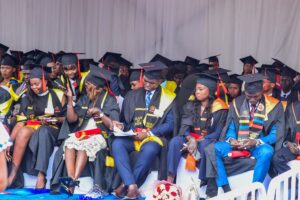
During the ceremony, a total of 465 students graduated with certificates, diplomas, bachelor’s, postgraduate and master’s degrees in various disciplines.
Of these, 224 were male (48%) while 241 were female (52%).
Six students graduated with first-class honours, with Vanessa Atuhaire emerging the best overall student with a CGPA of 4.63 in Bachelor of Information Technology. She was followed by Paskal Bwire, who obtained a CGPA of 4.60, also in Bachelor of Information Technology.
Speaking at the ceremony, the university vice chancellor Dr Charles W. Masaaba revealed that the institution is shifting to a competency-based education model aimed at equipping students with practical skills.
“All academic programmes at SLaU are now being redesigned and will be delivered using a competency-based model,” he said.
Masaaba explained that the university is investing in staff capacity building through continuous training, digital tools and professional development to support the new learning approach.
“We are moving away from a teacher-centred approach to a student-centred model where learners actively participate in problem solving, project-based learning, collaborative work and experiential learning,” he said.
He urged the graduates to apply their knowledge responsibly and contribute positively to their communities.
“You carry with you more than certificates and transcripts. You carry competencies, values and responsibilities. The world expects you to innovate, lead and transform society using knowledge and ethical judgement,” Masaaba said.
The graduation ceremony was held under the theme “Integrating Artificial Intelligence in the Competency-Based Curriculum.”
Vice-President Maj. (Rtd) Jessica Alupo, who is also the university chancellor, challenged higher education institutions to align academic programmes with competency-based education and emerging technologies such as AI.
“Uganda’s development agenda requires graduates who can create jobs rather than wait for them,” Alupo said.
“The future demands graduates who can think critically, create solutions and address real community challenges — not merely memorise content,” she added.
The university council chairperson Dr Mike Sebalu reaffirmed the council’s commitment to supporting the institution’s strategic direction.
“The council is committed to periodically reviewing the university’s strategic plan to ensure it keeps pace with contemporary issues in the market including digital transformation, employability and global competitiveness,” Sebalu said.
He added that strategic agility is essential for universities to remain relevant in a rapidly changing world.