













By Leonard Kamugisha Akida,
KAMPALA
The Irish Ambassador to Uganda and Rwanda, Mags Gaynor, has condemned the alleged sale of government jobs in Uganda, warning that the vice undermines integrity and wastes the country’s human resource potential.
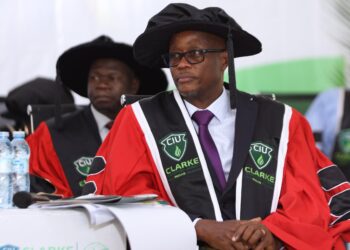
Speaking as chief guest at the 16th graduation ceremony of Clarke International University in Muyenga, Kampala, on Friday, Gaynor said the practice locks out qualified professionals and erodes public trust in institutions.
“Many boda boda riders are actually qualified doctors and nurses. When I ask them why, they tell me they are being asked for a year’s salary — Shs10m, Shs14m, to get a government job,” she said.
She described the situation as “tragic”, noting that it wastes talent, family sacrifices and investments in education, while weakening Uganda’s health system.
“It is a loss for Uganda’s human capital. When you become decision-makers, do not perpetuate the system. Act with integrity and lead by example,” Gaynor advised.
Her remarks come against the backdrop of recent findings by the Office of the Auditor General, which have exposed deep-rooted integrity gaps in public sector recruitment and payroll management.
According to audit reports, the public service currently has over 301,600 vacant positions, with critical sectors such as referral hospitals operating at vacancy rates as high as 71%, a situation experts say creates fertile ground for job selling and manipulation of recruitment systems.
The audits also revealed payroll fraud, including illegal compensation amounting to sh46.8b paid to 1,389 public servants irregularly absorbed into government structures. In addition, previous reports have consistently flagged the existence of “ghost workers”, individuals who are paid salaries despite not existing or not performing any work, often linked to fraudulent recruitment schemes.
Further findings from a 2025 report by the Inspectorate of Government indicate that more than 130,000 civil servants bribed their way into public office.
Research conducted with the Makerere University’s Economic Policy Research Centre showed that at least 35% of civil servants, about 133,000 out of 480,000, paid between UGx3m and UGx50m to secure jobs.
The study, which examined recruitment processes between 2018 and 2022 by District Service Commissions, further established that applicants were asked for bribes totalling sh78b, of which about sh29b was actually paid.
Meanwhile, the State House Anti-Corruption Unit has in recent months arrested several district officials in areas including Mitooma, Mpigi, and Bushenyi over allegations of soliciting bribes from job applicants. Some suspects have been arraigned in court, while others remain on bail as investigations continue.
A total of 501 students graduated in disciplines including nursing and midwifery, public health, business, applied technology, allied health sciences and education.
Gaynor urged the graduates to uphold honesty, accountability and professionalism in their careers.
“When you act with honesty, fairness and accountability, you not only uphold your profession, but you elevate it. Be the change you want to see,” she said.
The university’s vice-chancellor, Rose Clarke Nanyonga, said the institution is aligning its programmes to the competence-based education and training (CBET) model as directed by the Ministry of Education and Sports.
“We are working collaboratively with other universities to prepare for students who will join us next year,” she said.
Clarke noted that the learner-centred curriculum emphasises practical skills, with up to 60% of training conducted through clinical placements under partnerships with health institutions.
The shift to competence-based learning is aimed at aligning higher education with revised O- and A-level curricula, focusing on hands-on experience and employable skills.
The National Council for Higher Education has warned that institutions that fail to align programmes to the new model by the 2027/2028 academic year will not be allowed to admit first-year students. However, Clarke said CIU is fully prepared for the transition.
During the ceremony, Ugandan surgeon Charles Olaro was installed as Professor of Practice at the university.
Clarke said the move is part of efforts to integrate industry expertise into teaching.
“We want to bring experts closer to learners and shift from traditional promotion criteria to practical experience,” she said.
In his remarks, Olaro pledged to use the appointment to mentor students and improve healthcare access and management.
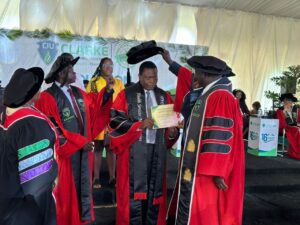
“I look forward to building leadership and strengthening health systems in Uganda and beyond,” he said.
The university chancellor, Henry Galukande, echoed calls for integrity, urging graduates to prioritise ethics alongside competence.
“You may be competent and available, but without ethics you will be in trouble. Let integrity be your anchor,” he said.
Galukande also encouraged continuous learning to remain competitive in a changing job market.
The ceremony was the first since CIU attained charter status in July last year, a milestone the university said strengthens its academic standing and will support the introduction of new undergraduate and postgraduate programmes, particularly in the sciences.