









By Carolyne Muyama,
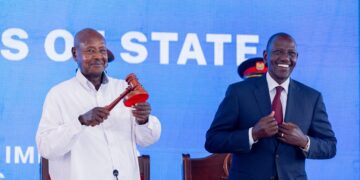
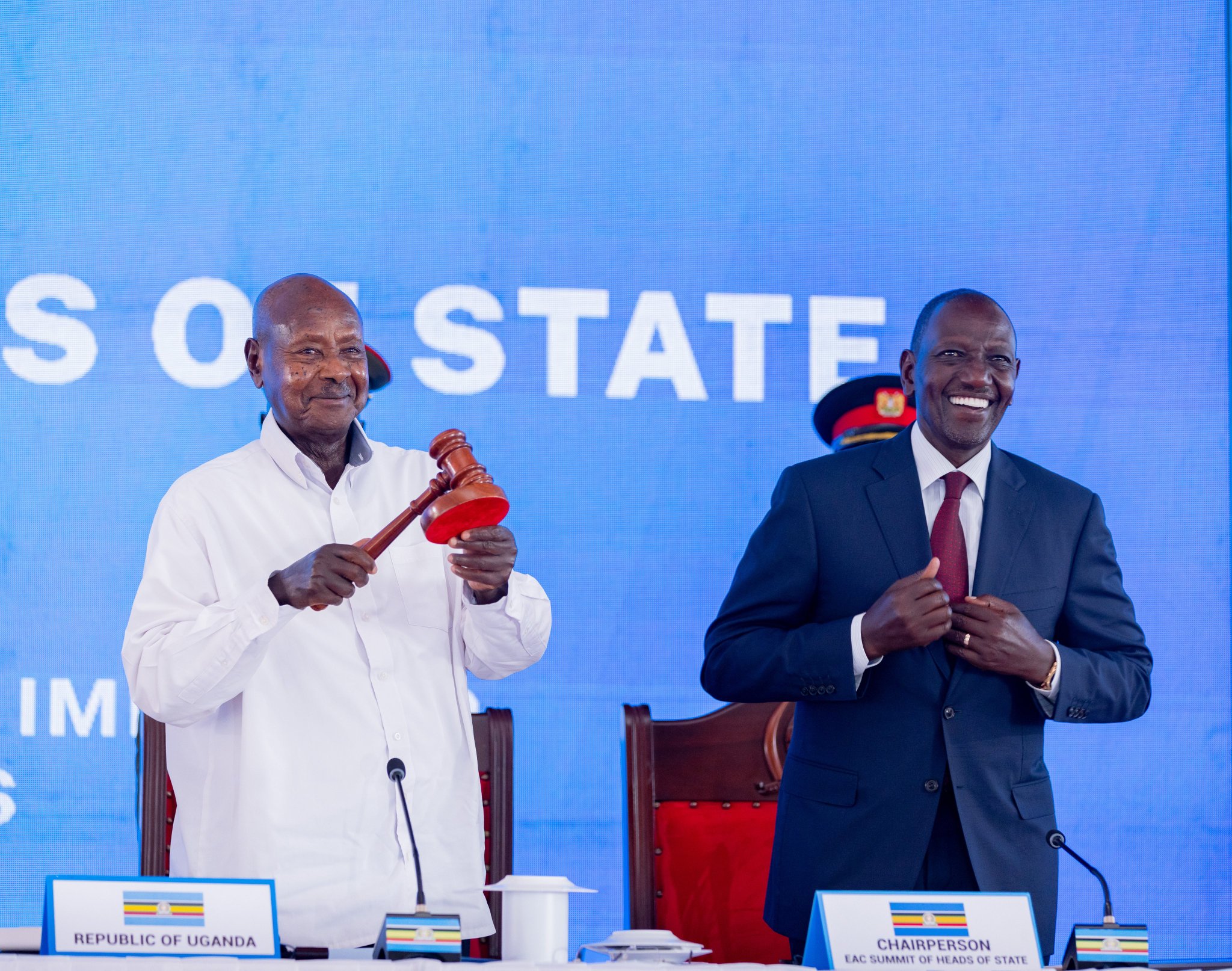
When President Yoweri Museveni assumed the chairmanship of the East African Community (EAC) from Kenya’s President William Ruto in Arusha on March 7, 2026, many described the transition as a shift from a rapid-strategic-approach to an institutional discipline. For many across the region, it was a moment of returning to “old hands.”
As a founding father of the revived EAC bloc, President Museveni takes over a community that has grown significantly larger but also become much more complex to manage. The transition marks a shift from Ruto’s fast-paced, business-focused approach to a period when the region must now focus on following its own rules and managing its own responsibilities. It is time for East Africa to solve its own problems rather than rely heavily on external actors, and for this to happen, political stabilization is essential.
President Ruto strongly supported businesspeople and regional trade. He introduced and promoted policies that simplified the movement of goods across borders. A key reform was the EAC Customs Bond, which allowed traders to use a single guarantee rather than pay separate security deposits at each border when transporting goods between member countries. Due to these improvements, trade among EAC countries grew significantly, reaching approximately $18 billion by mid-2025.
There was also a shift in who holds influence. Kenya is no longer the bloc’s only long-standing economic powerhouse. Kenya was considered strong because of its robust private sector, the port of Mombasa, and its role as the region’s financial hub.
Tanzania, under President Samia Suluhu Hassan, has stepped up its efforts. The country has intensified economic reforms and made significant investments in infrastructure, particularly in ports such as the Port of Dar es Salaam. With improved ports and renewed reforms, Tanzania is now outperforming Kenya in several trade sectors.
This shift has expanded Uganda’s economic options. Instead of mainly depending on Kenyan infrastructure and markets, Uganda can now trade through Tanzania, use alternative transport routes, and negotiate better regional trade terms. As the chair of the EAC, President Yoweri Kaguta Museveni has maintained strong relations with both economies, ensuring neither feels sidelined.
The biggest challenge facing President Museveni is the community’s empty bank account. The EAC is currently broke, owing nearly $89 million in unpaid membership dues. His role will be to act as the region’s “debt collector.” He needs to persuade member states to settle their arrears and enforce financial discipline within the community. The member states with the largest debts are the Democratic Republic of Congo, South Sudan, and Burundi.
The bloc adopted a new funding rule under which half the budget is shared equally among the member states, and the other half is allocated according to each economy’s strength. New rules state that if you don’t pay, you lose your right to vote or even to nominate people for major regional positions.
Perhaps the most important change President Museveni will oversee is how decisions are made. Previously, the EAC operated under a consensus system, meaning every member country had to agree before a decision was adopted, and even if one country disagreed, the decision could not move forward. This slowed regional progress as negotiations with one country stalled.
Now, the region has shifted to a 65% majority rule. This is a game-changer. It means the bloc can finally move forward on security, trade, and infrastructure development even if one or two members are hesitant. As chair, President Museveni must ensure that decisions remain inclusive and fair, that all interests are respected, and that voting isn’t dominated by larger economies or more powerful states.
On the security front, the situation in Eastern DRC remains a continuous challenge. While President Ruto’s “Nairobi Process” kept talks alive, the fighting persists, leading to refugee flows, cross-border militias, and illegal trade.
Perhaps the long-standing relationships President Museveni has with the leaders of DRC and Rwanda may influence diplomatic efforts to resolve the conflict between the two. The region now looks to him to go beyond quick fixes and create a strong Regional Security Pact. Considering Uganda’s experience in Somalia and South Sudan, there is hope that we can finally build a regional force that works together effectively instead of in isolated efforts.
For the average Ugandan, the focus is on the railway tracks. The Standard Gauge Railway (SGR) is central to this integration. With the launch of the Naivasha–Malaba link this month, the dream of a high-speed train from Mombasa to Kampala is finally becoming a reality. If President Museveni can keep this project on schedule and reduce goods transit time from the coast to just four hours, he will have achieved more for the muntu wa wansi (common man) than any diplomat. The coming months will show whether he can turn his extensive experience into the tangible results the region urgently needs.