













By Gilbert Akampa Kakurugu
NATIONAL
In a landmark ruling, the Constitutional Court has struck down the Computer Misuse (Amendment) Act, 2022, declaring it unconstitutional and a violation of fundamental freedoms.
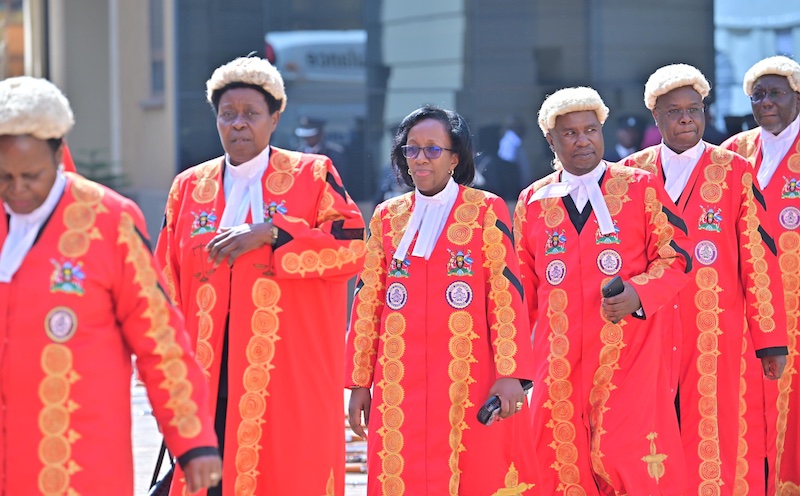
Delivering the judgment, Justice Ketrah Kitariisibwa Katunguka (JCC) concurred with her colleague Justice Irene Mulyagonja (JCC), finding that Parliament failed to comply with its own Rules of Procedure when passing the amendment. Specifically, the court held that the enactment violated Rule 24(3) of Parliament’s procedures under Article 94 of the Constitution, rendering the law null and void.
Parliament’s passage of the Computer Misuse (Amendment) Bill, 2022, without adherence to Rule 24(3), contravened Articles 88 and 89 of the Constitution.
As a result, the Computer Misuse (Amendment) Act, 2022, and the challenged provisions of the 2023 edition were declared unconstitutional.
The definition of “libel” under Section 162 of the Penal Code Act was found to be vague and inconsistent with Article 19(3)(a) of the International Covenant on Civil and Political Rights (ICCPR).
Sections 162 and 163 of the Penal Code Act were ruled incompatible with Uganda’s obligations under the African Charter on Human and Peoples’ Rights, as well as the National Objectives and Directive Principles of State Policy.
The ruling effectively nullifies provisions that had been widely criticized for curtailing freedom of expression, particularly in the digital space. Civil society groups and human rights defenders have long argued that the Computer Misuse Act was being used to stifle dissent and criminalize online speech.
The Court also issued a permanent injunction restraining the state from enforcing the annulled provisions, marking a significant victory for advocacy.
Uganda’s legal framework on freedom of speech has faced scrutiny in recent years, with international bodies urging reforms to align domestic laws with global human rights standards. This judgment signals a decisive step toward safeguarding constitutional freedoms and ensuring that legislative processes adhere strictly to the rule of law.