










By Leonard Kamugisha Akida
KAMPALA
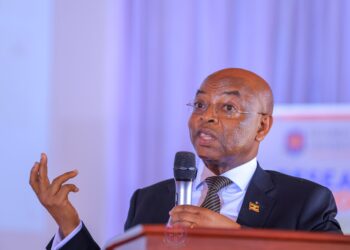
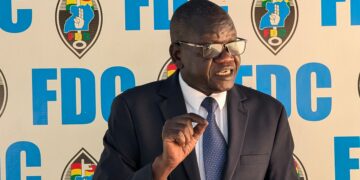
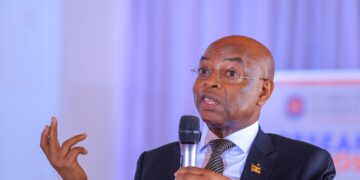
Forum for Democratic Change (FDC) president Patrick Oboi Amuriat has said the party will only participate in national dialogue if clear conditions, including a neutral convener, agreed agenda and venue, are guaranteed.
Amuriat said the party would not engage in talks intended to serve the interests of individuals seeking financial benefits from the Government Consolidated Fund rather than addressing the country’s political and governance challenges.
“We are not going to participate in dialogue where there are people whose main objective of dialoguing is getting money or resources from the consolidated fund account for themselves. We will also participate in dialogue where there is a neutral venue guaranteed,” Amuriat said.
He was addressing journalists on the state of the nation at the FDC headquarters in Najjanankumbi, Kampala, on Tuesday.
Amuriat acknowledged Uganda urgently needed dialogue to address what he described as confusion, deprivation and uncertainty facing citizens, but was quick to call clear grounds to facilitate this dialogue.
His remarks follow lady week’s Kirema Heritage farm consultative meeting in which political parties with representation in parliament under their IPOD umbrella agreed to work with the ruling NRM to promote national dialogue. FDC and NUP snubbed the meeting.
Amuriat said the FDC remained open to structured and meaningful discussions aimed at restoring democracy, protecting human rights, upholding the rule of law, ensuring good governance and securing the release of political prisoners.
However, he cautioned against what he described as politically motivated engagements designed to achieve political expediency rather than resolve national challenges.
“They want us to keep watching them and their tendencies of attempting to return the movement kind of system through the CDF. We are clever enough to act upon it,” he said.
Amuriat outlined several conditions the party wants considered before participating in any dialogue.
He said the talks must have an agreed agenda, arguing that the party would not attend meetings without clearly defined issues for discussion. The FDC argues that any meaningful dialogue must address settling of cases involving all political prisoners including their founding president Dr Kizza Besigye, former party vice president for Buganda, Erias Lukwago, respectively as well as allowing leveled ground for all political actors to operate freely without interferences.
He also insisted that the process should be facilitated by a neutral convener who has no vested interests or involvement in the issues being discussed.
The FDC president further called for clearly defined participants, questioning the involvement of what he described as briefcase political parties seeking to position themselves as key players in the proposed dialogue.
He also said that if the process involved specific tasks, the Government should establish a comprehensive legal framework to guide the dialogue instead of allowing it to become what he termed a “Saleh project”.
“We have our own doubts about the proposal by Gen. Salim Saleh of a Consociational Democracy Agree (CDA). Our skepticism arises from where the need for such dialogue suddenly arises yet the NRM has been around for 40 year and has also always stated that they can run the state without the opposition,” Amuriat said, listing conditions for the dialogue.
“In order to rule out the doubts about the intention of the CDA there is need to deliberately give an intuitive notice pointing at the honesty by government to implement the CDA.”
The former presidential candidate (2021) also questioned the state of constitutionalism and democratic governance in Uganda, citing the removal of presidential term limits in 2005 and the presidential age limit in 2017 as developments that weakened safeguards against excessive concentration of power.
He cited Article 1 of the Constitution, which establishes the sovereignty of the people, and Article 29, which guarantees fundamental freedoms, including expression, assembly and association.
“These are not gifts from government. They are constitutional rights,” he said.
Amuriat further accused the Government of weakening democratic principles, claiming that Members of Parliament from the ruling NRM were increasingly unable to freely express themselves even on the floor of Parliament.
“Do we still have a constitution?” he asked.
He argued that democracy should go beyond holding elections to protecting citizens’ ability to make meaningful political choices.