










By Leonard Kamugisha
BUSHENYI
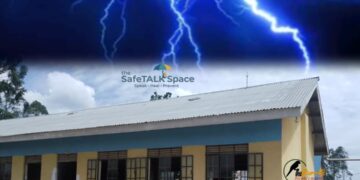
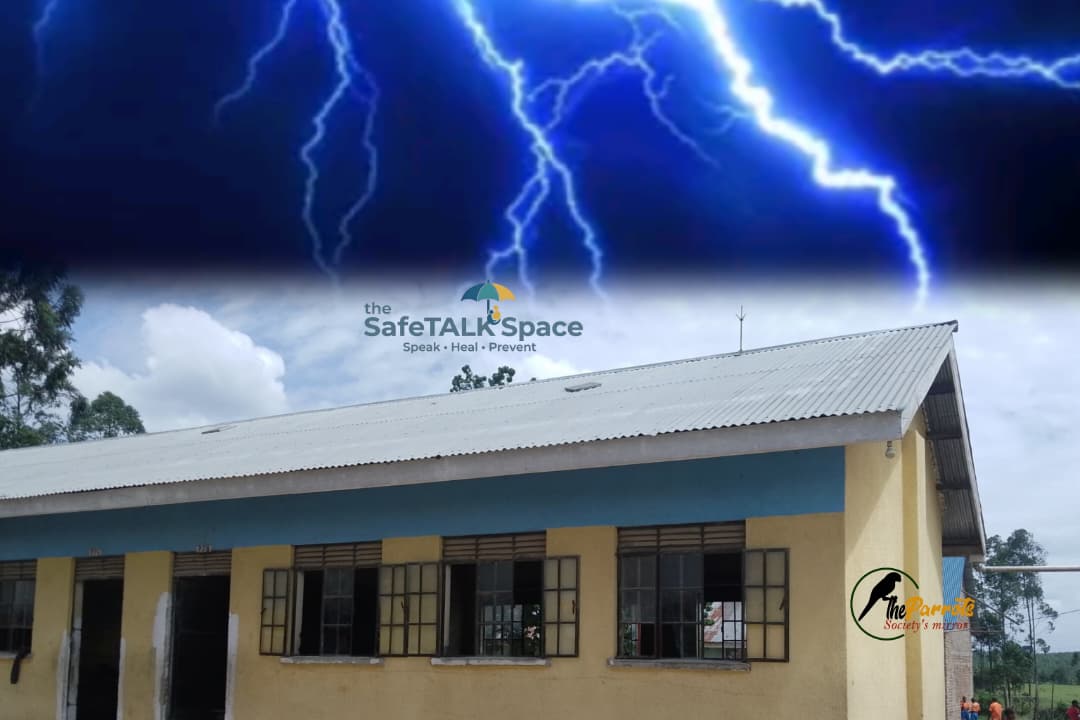
Methodious Mutungi was conducting an afternoon lesson when a sudden loud sound accompanied by a view once lightning struck Rwengiri Primary School.
The primary three and four teacher recalls the Tuesday June 19, 2025, incident which claimed two lives and injured 12 others.
“When lightning struck, I found myself lying unconscious in a corner at the back without shoes on my feet,” he says, as he remembers hearing a thunderbolt that left him unconscious.
The 32-year-old Literacy teacher was among the victims that were affected by lightning that fateful evening which left the school devastated with learners living under fear.
Following this shocking incident, he recalls, children were afraid to return to the affected classrooms.
“Even unusual sounds, such as a book falling, could startle them,” Mutungi told Parrots Media during an interview on November 19.
He added: “Pupils first feared using that classroom which was struck by lightning. Some of us teachers were also frightened.”
The school was prompted to seek for
Counselling and psychosocial support from individuals and the church, to enable its learners and frightened teachers recover from the lightning shock.
Lightning, which appears as a natural normal occurring is costing lives of learners and other individuals in schools in western region with authorities warning that delayed averting will cost more in the coming few years.
The US NOAA National Severe Storms Laboratory defines Lightning as a giant spark of electricity in the atmosphere between clouds, the air, or the ground.
Eng Isaac Lubega Sempogo from the National Building Review Board (NBRB) notes that lightning which has become a silent time bomb is always a powerful electrostatic discharge occurring within the atmosphere, can heat the air to temperatures as high as 30,000°C, hotter than the surface of the sun.
Eng Ssempogo notes that while most lightning occurs within clouds, it is cloud-to-ground strikes that pose the greatest danger, often with devastating consequences.
NBRB latest report show that Northern, Western, and West Nile regions are among the most hard hit regions with lightning.
Across Uganda’s western districts of Sheema and Bushenyi, repeated tragedies are raising questions about whether schools and communities are adequately protected, and why children continue to be exposed.
In February this year, two pupils were killed when lightning struck them in St. Mary’s Catholic Church compound in Bushenyi District. Just months earlier, in November 2025, another pupil died and five others were severely injured at St. Augustine Nursery and Primary School in Buliisa District after a similar incident.
A similar trend in all these affected schools is that the shock leaves the children frightened and visible fears among children is seen when the sky darkens or rain threatens.
In Rwengiri primary school, officials say the incident exposed gaps whose signs of closing is yet to be realised.
They note that the school is still exposed due to lack of adequate protection from a hazard that can strike without warning.
Protection built with community money
At Rwengiri Primary School, the lightning strike forced the administration to examine what had gone wrong.
Headteacher Bernard Bangirana says an assessment found that the school did not have an adequate lightning protection system. The large number of pupils and congestion in classrooms also raised concerns about their exposure during thunderstorms.

Parents, members of the Parent-Teacher Association (PTA) and well-wishers mobilised money to install six lightning arresters across five school buildings.
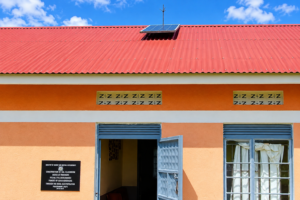
These metal rods are connected to the ground through conductors, providing lightning with a safer path into the earth instead of through a building.
But the protection is incomplete.
Bangirana says some buildings remain without arresters, including two blocks in the teachers’ quarters and a newly constructed classroom block.
“We made sure that each block had at least one lightning arrester, but there are about three blocks that are not protected. This puts the lives of both teachers and learners at risk,” he says.
The school has also struggled to meet recommended standards for the number and positioning of arresters.
Bangirana says the school reported its needs to the district authorities through the District Education Officer, but has not received the requested assistance.
“We hope that when we get these arresters, we shall close that exercise and ensure safety of learners and teachers and school property,” he says.
Despite the tragedy, enrollment has continued to rise, from 824 pupils last year to 918 currently. The school’s academic performance also remained strong that year. Of the 76 pupils who sat the Primary Leaving Examination (PLE), 74 passed in Division One, while two attained Division Two.
Bangirana attributes this partly to the support given to pupils, teachers and parents after the incident, which helped the community understand that lightning was a natural disaster rather than a reason to abandon the school.
But growing numbers of pupils also mean more pressure on classrooms and school infrastructure.
A history of deadly strikes
Like NBRB report states, our probe shows that Rwengiri is not the only affected school.
In neighbouring Bushenyi district, lightning has killed School children in several incidents over the past decade.
On 24 July 2014, lightning struck Buramba Primary School, killing eight pupils and injuring 17 pupils and a teacher.
A year later, in November 2015, five pupils died and four others were injured at Nyakabingo Primary School in Kakanju sub-county, Igara West County.
The school’s acting deputy headteacher, Polline Asasira, recalls that afternoon heavy downpour when lightning struck.
“Five pupils died and four others were rushed to hospital for treatment, where they recovered well,” she says.
At the time, the school had one lightning arrester. Following the tragedy, parents and well-wishers contributed money to install another.
A subsequent assessment reportedly found that the existing arrester was installed on a shorter building, while a taller structure nearby may have been more exposed.
The school now has three arresters, including one installed on a newly constructed classroom block and another on the administration building.
Asasira says the school has not recorded a similar incident since the installations.
“The arresters have restored sanity in the school. Pupils, teachers and the whole community are living safely,” she says.
But she remains concerned that the number of arresters is inadequate to protect all the buildings. The school also lacks sufficient money for regular inspections and maintenance.
“As a school, we do not have adequate funds to employ a technician to regularly survey and maintain the arresters we have,” she says.
The Ministry of Education standards requires schools to have stand alone lightning protection system (sweeter) installed on every standalone block, including: classrooms, dormitories, administrative offices, laboratories, and dining halls.
Similarly, the Uganda National Building Code (2020) requires that all public buildings, including schools, hospitals, churches, and halls, be equipped with lightning protection systems.
Eng Ssempogo says that these
systems typically include lightning rods, down conductors, grounding systems, and surge protection devices designed to safely channel electrical energy into the earth.
Children exposed beyond the classroom
Lightning does not only threaten pupils inside school buildings. Children walking home for lunch, returning to school in the afternoon or grazing animals may find themselves exposed when thunderstorms develop.
In February 2026, two pupils at St Mary’s Primary School in Kyamuhunga, Bushenyi, were struck by lightning while returning to school after lunch at home. The strike happened in a church compound.
Although the church reportedly had a lightning arrester, the children were struck in an open area. Attempts to obtain a comment from the headteacher Mrs. Omweigarire Byamukama on whether the church’s lightning arrester had been inspected after the incident were unsuccessful, as she declined to speak to the media.
The resident priest also declined to comment, citing lack of authorisation and the Parish Priest’s absence.
Safety experts say the incident highlights the dangers of being outdoors during thunderstorms, even near buildings fitted with protection.
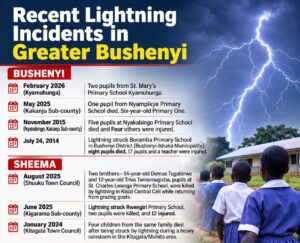
In Sheema, two brothers, 14-year-old Demus Tugabirwe and 12-year-old Triva Twinomugisha, died in August 2025 after lightning struck them as they returned from grazing goats in Kisizi Central Cell, Shuuku Town Council.
They were pupils at St Charles Lwanga Primary School.
In January 2024, four children from the same family died after lightning struck during a heavy rainstorm in the Kitagata-Muhito area.
The incidents show that protection at school alone may not be enough.
Children also need information about where to seek shelter and when it is dangerous to travel or remain outdoors.
The cost of protection
Uganda’s National Building Code (2020) requires public buildings, including schools, hospitals, churches and halls, to have lightning protection systems such as lightning rods, down conductors, grounding systems, and surge protection devices designed to safely channel electrical energy into the earth.
But the National Building Review Board says many buildings, particularly older schools, rural homes and places of worship, remain unprotected.
Even buildings with lightning arresters may not be safe if the systems are poorly installed, damaged or not maintained.
The board estimates that installing a lightning protection system can cost about Shs7m for a single-storey building and up to Shs15m for multi-storey structures.
For schools operating on limited budgets, such costs can be prohibitive.
Some experts are promoting cheaper alternatives, including locally available materials to improve grounding systems.
The National Building Review Board says these approaches can reduce installation costs by about Shs1m in some cases.
But cheaper systems still need proper installation and maintenance to be effective.
For many schools, the choice is between finding money they do not have and continuing to operate with incomplete protection.
Government promise, funding gap
At the commemoration of International Lightning Safety Day at Palabek Secondary School in Lamwo district in 2025, Education Minister Janet Museveni pledged that the government would strengthen lightning protection in schools.
“The Ministry of Education and Sports, through our Construction Management Unit, is committed to ensuring that both new and existing school structures across Uganda are fitted with proper lightning protection systems,” she said in a recorded message.
However, a nationwide installation programme has yet to materialise.
Education ministry permanent secretary Kedrace Turyagyenda acknowledges that schools are required to install lightning arresters but says the government lacks the funding to provide them to every school.
“It’s a requirement that schools should install lightning arresters, but the only challenge we have is financing. The ministry does not have money to give to each school,” she says.
She adds that some communities considered particularly vulnerable have been identified for possible support, but funding remains a major constraint.
For schools such as Rwengiri, the promise has yet to translate into additional protection.
Bangirana says no government-installed arrester has been provided at his school since the June 2025 incident.
He is appealing for more protection, alongside funding to expand classrooms and reduce congestion.
A local shift in priorities
Local authorities are beginning to recognise that lightning protection needs to be considered alongside classrooms, toilets and other school infrastructure.
Wycliffe Bwebale, principal assistant chief administrative officer of Sheema district, says the district should begin allocating money for lightning arresters.
“We are constructing classroom blocks and toilets, but we need to budget for lightning arresters because it has been proved that Sheema district is a lightning-prone area,” he says.
He says the proposal could be presented to the district’s executive and council in the next financial year, potentially marking a shift in how school construction is prioritised.
Bwebale also urges parents to work through school management committees and PTAs to help provide protection where government support is not immediately available.
But expecting communities to fund their own safety raises another concern: poorer schools may remain the most exposed.
Learning to survive a storm
At Rwengiri Primary School, the memory of the strike remains, but the fear has gradually eased.
Mutungi says teachers have been sensitising pupils about precautions during thunderstorms, including seeking shelter in safer buildings and avoiding unnecessary movement outside when storms begin.
For the children, these lessons are now part of daily life.
But awareness alone cannot protect a pupil sitting in an unprotected classroom, or a child walking home when a storm suddenly breaks.
Across Sheema and Bushenyi, schools have survived lightning strikes, buried pupils and rebuilt confidence. Some have installed arresters through community contributions.
Others remain exposed.
The question is no longer whether lightning poses a danger. The deaths and injuries have already answered that. It is whether protection will reach schools before another storm turns a classroom, church compound or journey home into a scene of tragedy.
This story was produced with support from Media Challenge Initiative (MCI) and the African Centres for Lightning Education Network (ACLENet)