














By Leonard Kamugisha Akida,
KAMPALA
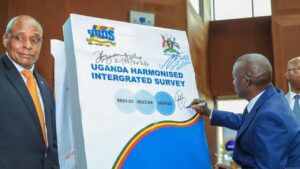
The Uganda Bureau of Statistics (UBOS) has released findings from the Harmonized Integrated Survey covering three waves conducted between 2021/22 and 2024/25, highlighting persistent poverty, rising school dropout rates and growing participation in the money economy.
The report was disseminated on Wednesday at the UBOS headquarters on Colville Street in Kampala.
Speaking during the release, UBOS executive director Dr Chris Mukiza said the survey provides updated statistics on household conditions, labour force characteristics, unemployment, housing, school attendance and access to green electricity, among other socio-economic indicators.
“The report contains information and statistics on gross output and value addition in both formal and informal enterprises. It tracks the transition from households to monetary economic practices, labour markets and property dynamics,” Mukiza said.
He said the bureau remains committed to producing quality data to support national planning and policy formulation.
Mukiza also revealed that UBOS will next Thursday release the 2025 Baseline Education Census report containing detailed statistics on Uganda’s education sector.
According to the survey findings, 66.9% of households are now participating in the money economy, while 33.1% remain engaged in subsistence production.
The report further revealed that 8.9% of Ugandans remained chronically poor throughout all survey years, while 14% fell into poverty and 9.7% managed to move out of poverty during the period under review.
The survey also raised concern over increasing school dropout rates. More than 60% of learners who were in Senior One during the 2021/22 survey wave failed to complete Senior Four, while 25% of pupils in Primary Seven did not transition to secondary school.
The findings also covered financial inclusion, agriculture, labour markets, employment and investment patterns.
UBOS board chairperson Dr Albert Byamugisha said the report would strengthen evidence-based planning and policy implementation in the country.
“This report provides timely and sustainable data on poverty, agriculture, employment, household welfare, access to financial services, education, labour participation and other key socio-economic indicators,” Byamugisha said.
He added that the findings would support monitoring of Uganda’s national development agenda, including implementation of the National Development Plan and the Sustainable Development Goals.
Byamugisha noted that the rapid growth of mobile money and digital financial systems presents an opportunity for Uganda to deepen financial inclusion and expand the country’s bankable population.
He said increased financial inclusion would improve business efficiency, boost domestic revenue mobilisation, reduce transaction risks and strengthen economic productivity.