














By Hellen Tusiime
KAMPALA
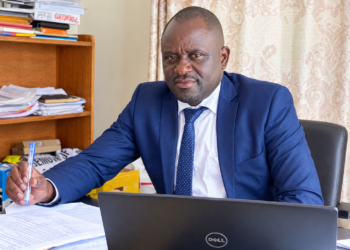
The Justice, Law and Order Sector (JLOS) faces a credibility challenge as citizens continue to experience gaps in access to justice, despite government promises to improve service delivery, Justice Minister Norbert Mao has admitted.
Mao said the experiences of ordinary Ugandans were not matching the commitments made by justice institutions, warning that the sector’s credibility was at stake.
“I want to admit as Minister of Justice that our credibility as the Justice Law and Order Sector is at stake because citizens’ experiences are not matching what we have been promising,” Mao said.
He made the remarks while announcing the 2026 National Justice Week, scheduled to run from November 23 to December 4, under the theme, Advancing Integrated People-Centred Justice, Law and Order Delivery System for Socio-Economic Transformation.
Mao said the event would provide an opportunity for the public to question justice institutions, share their experiences and identify areas requiring improvement.
He challenged the institutions to uphold equality before the law, professionalism, integrity, transparency and respect for human rights, regardless of an individual’s social or political status.
“There should be no going slow on anybody,” he said, urging prosecutors and other justice officials to perform their duties professionally without favouring influential individuals.
Mao also called on the media to focus on publicising practical justice services rather than concentrating only on official ceremonies.
He said the sector would use the annual event to strengthen public engagement and improve access to services, particularly for vulnerable communities and people living in remote areas.
As part of the activities, free legal aid clinics will be held at JLOS Towers from November 23 to 27, offering assistance to people with land disputes, family disagreements, employment grievances, succession matters and criminal cases.
The minister also announced seven public dialogues covering organised crime, juvenile justice, environmental and natural resource protection, commercial justice, family law and online gender-based violence.
A justice innovation hackathon will take place on November 24 and 25 at Twed Towers, bringing together young innovators to develop technology-based solutions to challenges affecting justice delivery.
Mao said digital transformation could reduce the cost of accessing justice, improve case tracking and strengthen fairness in the judicial process.
He also emphasised the need to address case backlogs through mechanisms such as plea bargaining, while ensuring that speedy trials do not compromise fairness.
The minister further called for increased legal aid, community mediation and public legal education, saying citizens needed to understand their rights and the available avenues for seeking redress.
On December 3, JLOS will hold recognition awards to honour individuals who have made outstanding contributions to justice and the rule of law, alongside its annual review and Justice Annual Forum.
Mao said the sector’s 25-year journey had registered progress, including increased judicial capacity, decentralisation of court services, automated case management and improved coordination among justice institutions.
He cited the establishment of a High Court in Lugazi and the decentralisation of the Court of Appeal to regional centres such as Mbarara and Gulu as examples of efforts to bring justice closer to citizens.
He said government remained committed to establishing a High Court in every district and a magistrate’s court in every constituency.
Mao also described justice as an economic necessity, arguing that reliable institutions protect property rights, enforce contracts and give investors confidence.
“When commercial disputes are resolved quickly, the cost of business comes down and then prices will be lower for citizens,” he said.
He added that access to justice protected people’s livelihoods and enabled them to participate more effectively in national development.
The Justice, Law and Order Sector brings together institutions responsible for the administration of justice, law enforcement and the protection of human rights. Its 25th anniversary celebrations will provide an opportunity to assess its achievements and address remaining challenges.
Mao said the ultimate measure of the sector’s success should not simply be the number of institutions established or services delivered, but whether ordinary Ugandans experience meaningful improvements in access to justice.