













By Serina Nagujja
KAMPALA
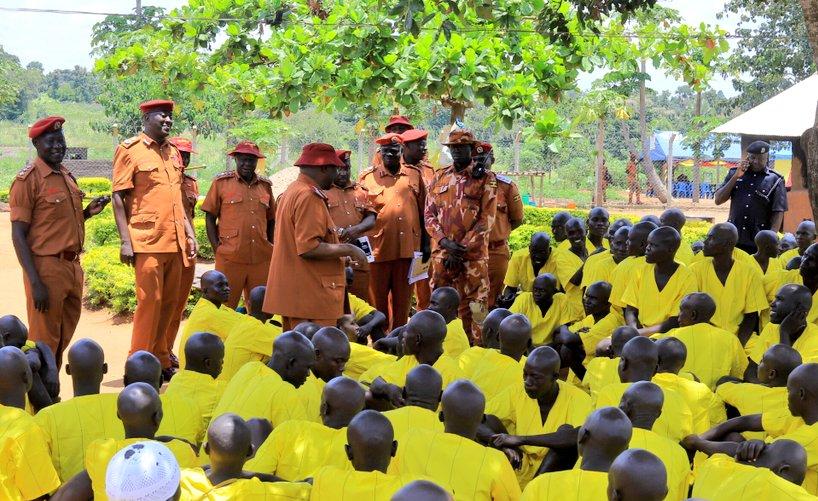
Uganda’s prisons are operating under severe pressure as the number of inmates continues to far exceed the available holding capacity, prompting the Uganda Prisons Service to advocate for a combination of legal, judicial and correctional reforms to address the challenge.
Recent figures from the Uganda Prisons Service indicate that 82,786 inmates are currently held across 270 prisons in 19 regions, managed by about 14,000 staff. The The population includes 44,594 convicts, 37,511 remands and 680 debtors.
This is more than three times the national holding capacity of approximately 23,000 inmates, creating significant pressure on prison infrastructure, personnel and resources while also affecting rehabilitation and the welfare of inmates.
Speaking in an interview, Prisons Spokesperson and Commissioner General of Prisons Dr Canon Johnson Byabashaija said addressing congestion requires more than simply expanding prison facilities.
Senior Commissioner of Prisons Frank Baine Baine says Uganda Prisons Service is supporting a multi-pronged approach that combines non-custodial measures with investment in prison infrastructure for offenders who genuinely require incarceration.
Parole as a pathway out of overcrowding
Dr Byabashaija said greater use of the parole system could help reduce the number of inmates remaining in prison after serving a significant portion of their sentences.
‘Under parole, eligible prisoners who have served part of their sentence and met the required conditions can be released to continue serving the remainder of their sentence in the community, subject to specified conditions and supervision’.
According to Dr Byabashaija, strengthening the parole system would give deserving prisoners an opportunity to reintegrate into society while continuing to hold them accountable for their offences.
He said the approach would also create room within prisons for inmates who require continued custodial supervision.
The emphasis, he explained, is not simply on releasing prisoners, but on ensuring that those considered for parole are properly assessed and are able to return to their communities responsibly.
A stronger parole system could therefore serve both rehabilitation and decongestion objectives by supporting the gradual reintegration of suitable prisoners rather than keeping every offender in custody until the final day of their sentence.
Building additional high-capacity prisons
While the Prisons Service is advocating for alternatives to incarceration, SCP Frank Baine said there remains a need to expand prison infrastructure because some offenders will continue to require custodial sentences. He said Uganda Prisons is proposing the construction of five major maximum-security prisons in different parts of the country.
The proposed facilities are planned for Kakiika in Mbarara, Gulu, Arua, Soroti and Mbale, with each facility expected to accommodate between 3,000 and 4,000 inmates. Baine pointed to Kitalya Maximum Security Prison as an example of the type of large-scale correctional facility that can help respond to Uganda’s changing correctional needs. The proposed expansion is intended not only to create additional space, but also to improve the conditions under which inmates are held and ease pressure on existing prisons.
ADR to keep appropriate cases out of prison
Senior Commissioner of Prisons Frank Baine Mayanja, who also spoke on the issue, said the prison population can be reduced by strengthening mechanisms that prevent appropriate cases from reaching custodial sentences in the first place. Among the measures he highlighted is Alternative Dispute Resolution (ADR). ADR uses mechanisms such as mediation, negotiation and reconciliation to resolve certain disputes without relying entirely on conventional criminal justice processes and imprisonment.
Baine said the approach can help reduce the number of people entering prisons while promoting accountability, reconciliation and restoration. For the Prisons Service, the wider use of ADR represents a shift towards a justice system in which imprisonment is not automatically treated as the first response in every case.
Community service
Baine also highlighted community service as another important non-custodial measure. Under community service, eligible offenders serve their sentences by undertaking work that benefits the community instead of being confined in prison.
The measure allows offenders to take responsibility for their actions while contributing positively to society. It can also help reduce the number of people serving short custodial sentences, which in turn frees up prison space for inmates whose offences and circumstances require incarceration.
Justice for people with mental illness
Another area of concern is the treatment of offenders with mental illness. Baine said the Justice for the Mentally Sick framework continues to face challenges, particularly in relation to the legal procedures used to determine cases involving people with mental illness. He said there is a need to address gaps in the system so that people suffering from mental illness receive appropriate care and justice instead of remaining in prison for unnecessarily long periods. The issue, he stressed, goes beyond decongestion. It is also about protecting vulnerable people within the criminal justice system and ensuring that mental illness is appropriately addressed through both medical and legal interventions.
Mandatory bail for long-standing High Court cases
Baine said the Prisons Service is also calling for consideration of a constitutional amendment to address cases involving people who spend prolonged periods on remand without being tried.
The proposal is that where a person committed to the High Court has not been tried within one or two years, the individual should be considered for mandatory bail, subject to appropriate legal safeguards. The argument is that an accused person should not remain in custody indefinitely simply because a trial has not taken place. Where the State is ready to proceed with the case and a hearing date is secured, mechanisms can be put in place to ensure that the accused returns to court to face trial. Such a measure, Baine argues, could significantly reduce the number of inmates held on lengthy remand and help ease pressure on prisons.
A challenge requiring more than one solution
Uganda’s prison congestion problem is ultimately a justice-system challenge that extends beyond the prison gates. With the inmate population currently standing at more than three times the available holding capacity, the pressure on facilities, staff and rehabilitation programmes is considerable.
The proposals being advanced by the Uganda Prisons Service therefore seek to address congestion from several directions: preventing unnecessary imprisonment through Alternative Dispute Resolution, expanding community service, strengthening parole, improving justice for people with mental illness, ensuring timely trials and consideration of mandatory bail for prolonged remand cases, and constructing additional high-capacity correctional facilities.
The approach recognises that not every person who comes into conflict with the law necessarily needs to spend time in prison, while also acknowledging that prisons remain necessary for offenders who pose risks that require custodial supervision.
For Uganda Prisons, the path to decongestion may therefore lie not in a single solution, but in a coordinated reform agenda that reaches from the courtroom and community to the prison gates and beyond.