










By Hellen Tusiime
KAMPALA
African countries have been urged to strengthen their economies and negotiating capacity to ensure that partnerships with China deliver meaningful benefits rather than reinforce existing inequalities.
Prof. Julius Kiiza, a political scientist at Makerere University, said African countries should recognise that China, like other global powers, pursues its national interests and should therefore approach cooperation with a clear understanding of what they want to achieve.
“China is definitely Africa’s ally, with a strong history of partnership with Africa. But friends, China is a sovereign state, not a charity house. China is not an NGO,” Kiiza said.
He was delivering the keynote address during a public lecture organised by Makerere University’s Confucius Institute at the university’s Main Hall on Friday, November 20.
The lecture was held under the theme, “Knowledge, Culture and Economic Transformation: Rethinking China-Africa Partnerships in a Changing Global Order”.
Kiiza questioned whether China-Africa relations represented genuine partnerships between equals, arguing that differences in economic and political power could create unequal relationships.
He said African countries needed to build their economic strength, industrialise and invest in technology to improve their bargaining position.
“The key incentive driving China is to project Chinese power across the world, not just in Africa. In diplomacy, therefore, I will invite Ugandans and other Africans to appreciate that you get what you negotiate, not necessarily what you desire for,” he said.
He urged African countries to learn from China’s economic transformation, particularly its investment in infrastructure, industrialisation, science and technology.
Kiiza also challenged African scholars to draw lessons from their own cultural values instead of relying entirely on Western development theories.
He called for African values to be strengthened and adapted to support economic transformation.
Makerere plans Chinese studies centre
Earlier, Makerere University Vice-Chancellor Prof. Barnabas Nawangwe announced plans to establish a Centre for Chinese Studies to expand the university’s engagement with China beyond language teaching.
He said the proposed centre would enable Ugandans to study China’s development experience and understand its economic transformation.
“Apart from the teaching of the Chinese language, we have decided that we are going to establish a Centre for Chinese Studies,” Nawangwe said.
He cited China’s poverty reduction experience, saying the country had lifted 400 million people out of poverty within 30 years.
Nawangwe also highlighted the university’s growing academic cooperation with Xiangtan University in China, particularly in engineering education.
Panel discussion examines practical cooperation
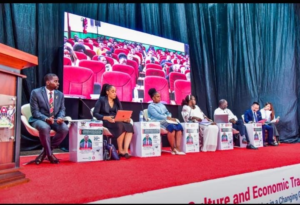
During a panel discussion moderated by Dr. Eunice Akulo, a lecturer in Political Science and International Relations at Makerere University, participants examined how China-Africa relations could translate into practical benefits for African countries.
The panel included Chris Mukama, a language educator ,Sarah Mirembe, a political science lecturer at Nkumba University and PhD candidate at Makerere; Godfrey Muhairwe, a Makerere PhD candidate and director of Dollar Travel Services; Hilda Ayebare, a Chinese translation specialist at the National Curriculum Development Centre; and Prof. Wang Weiyan, Director of the International Exchange Centre at Xiangtan University.
The discussions covered language education, cultural exchange, technology, economic development and the need for African countries to protect their national interests.
Ayebare called for increased investment in Chinese-language education, urging the government to support local teachers through better remuneration and additional training opportunities.
She said some Ugandans were discouraged from learning Mandarin by perceptions that the language was difficult and fears that Chinese-language education could lead to cultural domination.
She argued that learning Chinese should instead be viewed as an opportunity to improve communication, understand China’s development experience and strengthen economic relations.
 The discussion also highlighted the importance of university partnerships in research, staff development, technology transfer and skills training.
Makerere, Xiangtan sign MOU
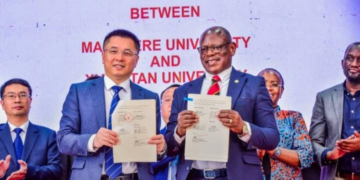
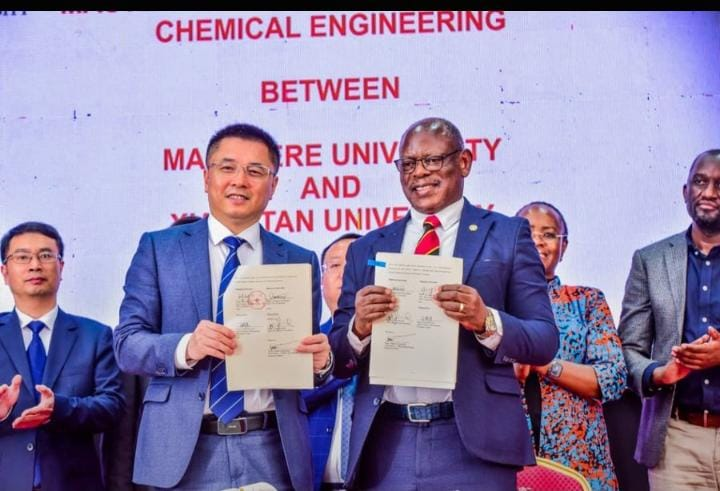
The lecture also featured the signing of an agreement between Makerere University and Xiangtan University for a 1+2 joint Master’s degree programme in Materials and Chemical Engineering.
The collaboration is intended to strengthen postgraduate training and academic cooperation between the two institutions.
The visiting delegation from Xiangtan University was led by Prof. Liu Jingang, Deputy Secretary of the university’s Communist Party Committee.
The partnership adds engineering education to the areas of cooperation between the universities as Makerere seeks to strengthen research, skills development and international academic exchange.