











By Hellen Tusiime
KAMPALA
Education scholars from seven East African countries have launched a regional association to promote comparable education standards, strengthen research collaboration and influence policies across the region.
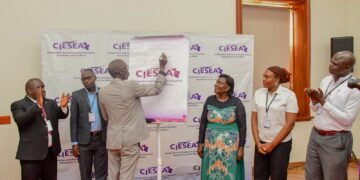
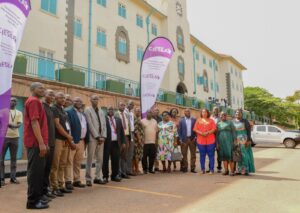
The Comparative and International Education Society of East Africa (CIESEA) was officially launched at Makerere University’s Main Building on Saturday, November 28, with scholars calling for education reforms that borrow from international best practices without overlooking local realities.
The association brings together education researchers, university lecturers, teacher educators, students and policymakers from Uganda, Kenya, Tanzania, Rwanda, Burundi, South Sudan and the Democratic Republic of Congo.
Dr Charles Muweesi, the association’s president and Director of Institutional Advancement at Busitema University, said East African scholars had previously relied on international associations and collaborations without having a sufficiently organised regional platform to coordinate their work.
He said the new association would enable researchers to work together, publish jointly and share experiences while addressing education challenges affecting their countries.
“That is why we are privileged to launch this society. It is not just for Uganda but for the entire East African region,” Muweesi said.
He said one of the association’s priorities would be to promote greater comparability of curricula, assessment systems and academic qualifications to support recognition of education obtained across the region.
Muweesi pointed to the transition towards Competence-Based Education and Training (CBET), saying universities were expected to align their curricula with the approach by 2027.
The association also intends to expand membership to include undergraduate and postgraduate students, lecturers and other education practitioners across East African universities, while strengthening research and innovation.
Moving beyond imported education models
Prof. Anthony Muwagga Mugagga, Principal of Makerere University’s College of Education and External Studies, who represented Vice-Chancellor Prof. Barnabas Nawangwe, challenged education scholars to reconsider the practice of adopting foreign education models without examining their suitability for local circumstances.
He said comparative education should enable countries to identify what works in other education systems, what does not and what can be adapted to their own contexts.
Mugagga cited Uganda’s competence-based curriculum as an important reform but questioned whether its implementation had been adequately supported.
He also raised concerns about the adoption of technology in education, noting that some countries were reviewing practices they had previously embraced, including the use of mobile phones in schools.
He urged the association to promote research into teacher education, language instruction, assessment, learner transitions and equitable access to education, particularly for girls, rural children and learners with disabilities.
Mugagga also challenged educators to examine the moral and social dimensions of education, arguing that academic qualifications alone should not be the only measure of an educated society.
He cited littering and poor sanitation in public institutions as examples of behaviour that education should help address.
Education policies must reflect local realities
Dr Robert Tomusange, a lecturer at Mountains of the Moon University and the association’s Secretary-General, said comparative education should examine differences within countries and communities rather than concentrate only on comparisons between nations.
He illustrated this using two learners assigned the same research task. One has access to a phone and assistance from adults at home, while another must wait until the following day to access a shared school device.
Although both learners may be assessed using similar standards, their circumstances are different.
“Results travel much further than the explanations behind them,” Tomusange said.
He cautioned against adopting policies simply because they had succeeded elsewhere, arguing that education reforms must be informed by evidence, adequate financing, teacher preparation and the participation of affected communities.
The association intends to provide a platform for ministries, curriculum development agencies, examination bodies, universities and district authorities to discuss reforms and develop policy recommendations.
It also plans to strengthen regional and international research partnerships and create opportunities for young scholars to participate in comparative education research.
The society’s official website identifies seven countries within its regional network and lists 160 partner universities and 1,000 individual members.
The launch marks an effort to establish a stronger regional voice in education research and policy discussions, with the ultimate goal of developing education systems that respond to East Africa’s social, economic and cultural realities.