










By Charles Katabalwa,
The IFPA-CD Project, led by the Ministry of Water and Environment (MWE) and supported by the World Bank, is implemented in collaboration with several government institutions responsible for forest and protected area management. These include the Uganda Wildlife Authority (UWA), the Office of the Prime Minister (OPM), and forestry technical teams that previously operated under the National Forestry Authority (NFA), which have since been integrated within the Ministry of Water and Environment’s forest management structures.
Reversing Years of Forest Degradation
In 2017, Kagombe Central Forest Reserve had experienced severe degradation, with nearly 80 percent of the forest area affected by encroachment. Once a vital watershed feeding the Muzizi River and Lake Albert, the reserve had lost much of its natural vegetation due to unsustainable human activities such as illegal timber harvesting, charcoal production, and agricultural encroachment.
Today, restoration efforts under the IFPA-CD Project are gradually reversing this trend through a combination of ecosystem restoration, community engagement, and strengthened forest governance.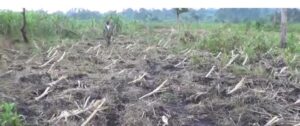
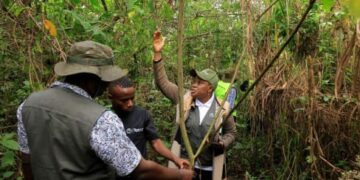
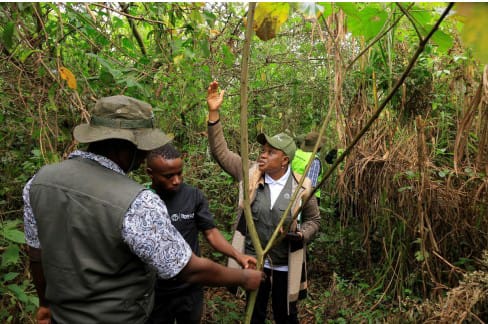
The technical field mission was led by IFPA-CD National Project Coordinator Margaret Athieno Mwebesa and World Bank Task Team Leader Anita Takura, accompanied by officials from the Ministry of Water and Environment, Uganda Wildlife Authority, and the Office of the Prime Minister. The team visited restoration sites and held discussions with local communities participating in forest restoration and conservation initiatives.
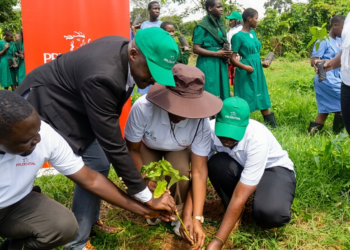
During the visit, Margaret Athieno Mwebesa emphasized the growing role of communities in sustainable forest management, noting that restoration efforts are increasingly being implemented through partnerships with local residents who actively participate in tree planting, maintenance, and protection of forest landscapes.
Restoring Biodiversity Through Indigenous Species
Under the IFPA-CD Project, restoration activities prioritize the planting of indigenous tree species that historically existed within the forest ecosystem. This approach helps restore natural biodiversity, rebuild ecological balance, and strengthen the resilience of forest landscapes to climate change.
Across the western landscape, several restoration and conservation interventions are currently underway:
In Kagombe Central Forest Reserves, approximately 1,000 hectares are undergoing restoration and enrichment planting.
In Bugoma Central Forest Reserve, restoration activities cover 1,500 hectares.
In Budongo Central Forest Reserve, the project supports enrichment planting across 310 hectares, alongside the maintenance of 50 kilometres of tourism and monitoring trails.
In Kashoya-Kitomi Central Forest Reserve, enrichment planting is being conducted on five hectares. In Busingiro, 40 kilometres of new forest trails are being established to strengthen conservation monitoring and support ecotourism management.
These interventions are designed to strengthen forest health while improving the capacity of conservation authorities to monitor and sustainably manage protected landscapes.
Communities at the Centre of Conservation
Beyond ecological restoration, the IFPA-CD Project is strengthening local livelihoods through Collaborative Forest Management (CFM) groups. These groups play a key role in conservation by participating directly in forest restoration activities while benefiting from sustainable livelihood opportunities linked to forest protection.
One beneficiary, Ayesimbwa Wilber, a member of the Bwikara Collaborative Forest Management Group, explained that the project has significantly changed community attitudes toward forest conservation.
He noted that many residents who previously relied on unsustainable forest exploitation for survival are now actively involved in protecting and restoring the forest.
Through the CFM programme, community groups have received 500 beehives, enabling members to engage in beekeeping as an alternative livelihood. The initiative helps reduce dependence on charcoal burning and timber harvesting while providing an additional source of household income.
To strengthen financial inclusion, the groups have also established a Savings and Credit Cooperative Organization (SACCO), allowing members to mobilize savings and invest in sustainable, forest-friendly enterprises.
Signs of Ecological Recovery
Gazetted in 1932, Kagombe Central Forest Reserve covers approximately 17,751 hectares and plays a critical role in maintaining the region’s hydrological system. The forest supports water flows that feed surrounding rivers, wetlands, and communities.
Encouragingly, communities and conservation staff have reported the return of chimpanzees to parts of the forest, a strong ecological indicator that the ecosystem is gradually recovering as restoration activities take effect.
A Model for Climate-Smart Conservation
The IFPA-CD Project, funded by the World Bank and implemented by the Government of Uganda through the Ministry of Water and Environment and its partner agencies, continues to demonstrate how integrated conservation approaches can deliver both environmental restoration and community livelihood benefits.
As the 2026 Technical Field Mission progresses across project landscapes, the restoration of Kagombe Central Forest Reserve stands out as a compelling example of how collaborative forest management, strategic restoration, and community participation can rebuild degraded ecosystems.
The continued partnership between government institutions, development partners, and local communities remains central to ensuring that these gains are sustained and expanded across Uganda’s forest landscapes, contributing to climate resilience, biodiversity conservation, and sustainable rural livelihoods.