












By Leonard Kamugisha Akida
RUBANDA
On the morning of Sunday, 25 July, John Tumukunde woke up like millions of devout Ugandans, preparing for a church service. A devoted 45-year-old family man and headteacher of Musamba Primary School, he had spent the preceding week following his usual rhythm: teaching pupils during the day and returning home each evening across the misty waters of Lake Bunyonyi.
By 09:30 AM, he was dead.
His tragedy began with an ordinary problem: Tumukunde could not find a boat to take him across the lake to attend his school’s thanksgiving service.

“He failed to find a boat, and I offered to transport him together with another passenger,” recalled Dickson Kamuhanda, the Nyombe Parish Male Councillor in Kahungye Sub-county.
Having offered to assist the stranded educator, Kamuhanda steered his small wooden canoe away from the Kyevu landing site in Butanda Sub-county, heading toward Bugo Village in Rubaya Sub-county. They had only just left the bank when the fragile vessel capsized.
While a 19-year-old passenger, Rebecca Ndamwesiga, was rescued from the freezing water and rushed to Kyevu Health Centre II, Tumukunde vanished beneath the surface.
A Five-Day Nightmare in Dark Waters
For Kellen Tumukunde, the headteacher’s widow, the days that followed were an agonizing blur.
“I spent the whole week with him, and on Saturday we were together,” Kellen said, holding back tears. “On Sunday, he left home at around 8:30 AM going to attend a service, and at around 9:30 AM, the incident happened. From that time, we searched for his body in vain.”
Lake Bunyonyi is famed for its breathtaking terraced hills and tourist allure, but it is also one of Africa’s deepest bodies of water. Reaching depth estimates of up to 900 metres, its dark, frigid depths render manual diving impossible without specialized gear.
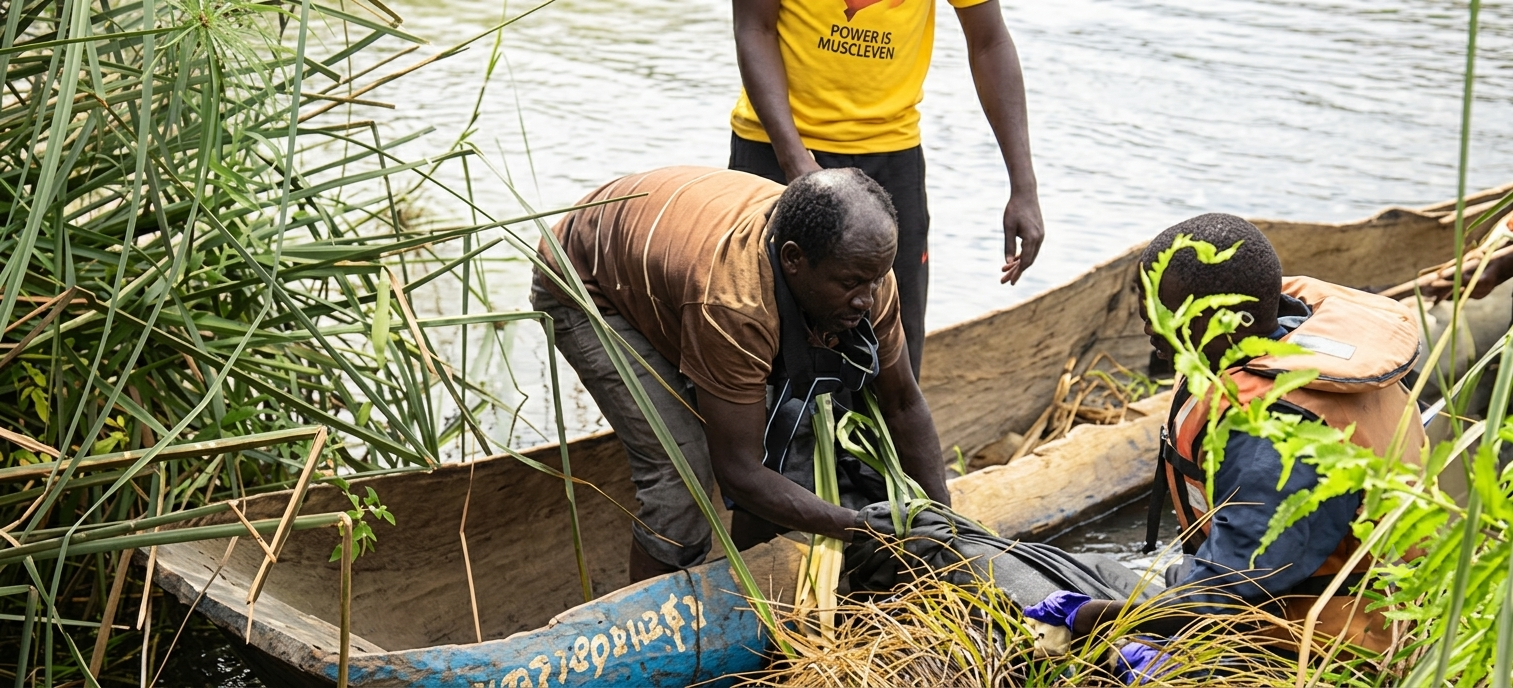
With no professional state divers or marine rescue teams arriving at the scene, local fishermen stepped into the breach using the only technology available to them: rusty, worn-out fishing hooks dragged along the lake bed.
Five days after the capsizing, a hook snagged a shred of Tumukunde’s clothing. His decomposing body was pulled to the surface.
“We used fishing hooks to search for his body,” one local fisherman explained. “The hooks were old and weak because they have been overused in these waters. We finally discovered him after a hook caught a piece of his clothes.”
Substandard Gear and Abandoned Promises
The tragic five-day search has reignited intense local anger over what residents describe as chronic government neglect along the lake’s shoreline.
Fishermen involved in the recovery effort revealed that underwater debris, heavy stones and sunken logs deposited along the lake floor, continuously snagged and snapped their substandard rescue gear during the five-day search.
Francis Asiimwe, a local fisherman and resident, believes the delays in retrieving Tumukunde highlight a lethal structural vacuum.
“One of the key challenges we face is that we do not have enough trained personnel,” Asiimwe said. “We are forced to use primitive local methods both to rescue lives and to retrieve bodies when people drown.”
Residents point out that while a single government ferry operates on the lake, it primarily serves commercial business traffic, leaving ordinary commuters and rural communities stranded in fragile, hand-paddled wooden canoes.
“We lack motor engine boats to transport our people,” one angry fisherman said.
“Every time, we have been asking the government to construct proper docks and provide motorboats, but it feels as if we are not Ugandans. Drowning happens frequently, but what hurts most is that when an incident occurs, there is not a single motorized emergency vessel to launch a search.”
Shifting the Blame
When confronted with the community’s allegations of systemic neglect, official authorities pointed the finger back at the victims.
Speaking for the Kigezi Regional Police, spokesperson SP Nelson Tumushime attributed the continuous loss of life on Lake Bunyonyi to non-compliance with existing safety standards.
“Before asking the police to help you, first help yourselves,” SP Tumushime said directly to local communities. “Moving on a boat at night is highly risky because you might drown. Furthermore, passengers must wear life-saving jackets while on the water.”
Yet, for the thousands who cross Lake Bunyonyi daily, including young children paddling themselves to school every morning, life jackets remain an unaffordable luxury, and engine boats are non-existent.
An old Ugandan proverb states that a bad day is seen in the morning. For the family of John Tumukunde, his fatal morning has become a symbol for an entire region where crossing the water to go to work or school remains a daily gamble with death.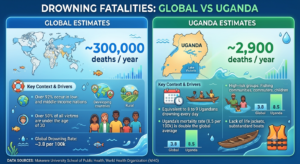
Drowning remains a silent global epidemic, claiming an estimated 300,000 lives each year worldwide. Over 92% of these fatal incidents occur in low- and middle-income countries, with more than half of all victims under 30 years old. In Uganda, the crisis is particularly acute: research from the Makerere University School of Public Health indicates that roughly 2,900 Ugandans drown every year, an average of 8 to 9 deaths every day. At 8.5 deaths per 100,000 people, Uganda’s drowning mortality rate stands at double the global average, driven primarily by unseaworthy wooden craft, a widespread lack of life jackets, and absent emergency marine infrastructure across the nation’s major lakes and waterways.
Drowning is Preventable: What the Global Data Shows
Despite the alarming statistics, international public health authorities emphasize a crucial message: drowning is almost entirely preventable.
Recent reports from the World Health Organization (WHO), the International Life Saving Federation (ILS), and Bloomberg Philanthropies underscore that targeted, low-cost interventions can drastically reduce fatalities. Under the global theme “Anyone can drown, no one should,” WHO highlights six evidence-based measures that save lives:
• Mandatory Life Jacket Compliance: Ensuring all passengers on commercial and commuter vessels wear approved personal flotation devices.
• Survival Swim & Water Safety Instruction: Teaching basic swimming and water rescue skills to children and high-risk occupational groups like fishermen.
• Safe Vessel Regulations & Inspections: Banning substandard, unseaworthy wooden craft and enforcing safe passenger limits.
• Community Creches & Childcare: Providing supervised daycare for young children in rural water-adjacent communities to prevent accidental falls.
• Standardized Search & Rescue (SAR): Equipping local water points with motorized emergency response boats and trained lifeguards.
• Public Awareness & Early Warning Systems: Educating water users on weather risks and hazards.
According to Bloomberg Philanthropies, survival swimming programs and community-led water safety initiatives have already driven a 16% reduction in child drowning deaths in pilot regions like Viet Nam, demonstrating that political will and targeted investment yield swift results.
Uganda’s Step Up: A National Strategy to Turn the Tide
In response to sustained advocacy, Uganda has begun laying the groundwork for a structured, multi-sectoral response.
The Ministry of Works and Transport, alongside the Ministry of Health and civil society partners, unveiled the National Drowning Prevention Strategic Plan (2025/26–2029/30). The strategy currently under the ministry of internal affairs (the department of marine police), its framework sets an ambitious target: reducing maritime and drowning fatalities on Uganda’s inland waterways by 25% by 2030.
The strategy also sets key components of Uganda’s ongoing drowning prevention efforts including:
✓ Safe Boating and Regulation: Enforcing the Inland Water Transport Act regulations and monitoring landing sites.
✓ Education and Swimming: Introducing water safety and survival swimming curricula for children and vulnerable groups, and strengthening legal enforcement against uncertified, night-time boat operators.
✓ Public Awareness: Running nation-wide community media campaigns on water risks and life jacket use.
✓ Rescue Capacity: Training first responders (Community-Led Peer Training) and local marine units in rescue and resuscitation. Pilot projects on Lake Albert and Lake Victoria where drowning survivors train fellow boaters on life-jacket enforcement and emergency response.
✓ Life-Saving Gear: Providing affordable flotation devices and setting strict equipment standards. Partnering with research institutes to develop low-cost, locally made flotation devices for subsistence fishermen.
✓ Infrastructure: Developing coordinated search and rescue systems across major water bodies.
✓ The Parliamentary Forum on Roads and Water Safety: Created to champion water safety legislation and mobilize budget allocations.
Despite these policy milestones, rural water-dependent communities such as those along Lake Bunyonyi, continue to face daily risks as they await tangible enforcement, equipment, and emergency resources on the ground.